Future state: trade, tides, crew, and a fuller bay
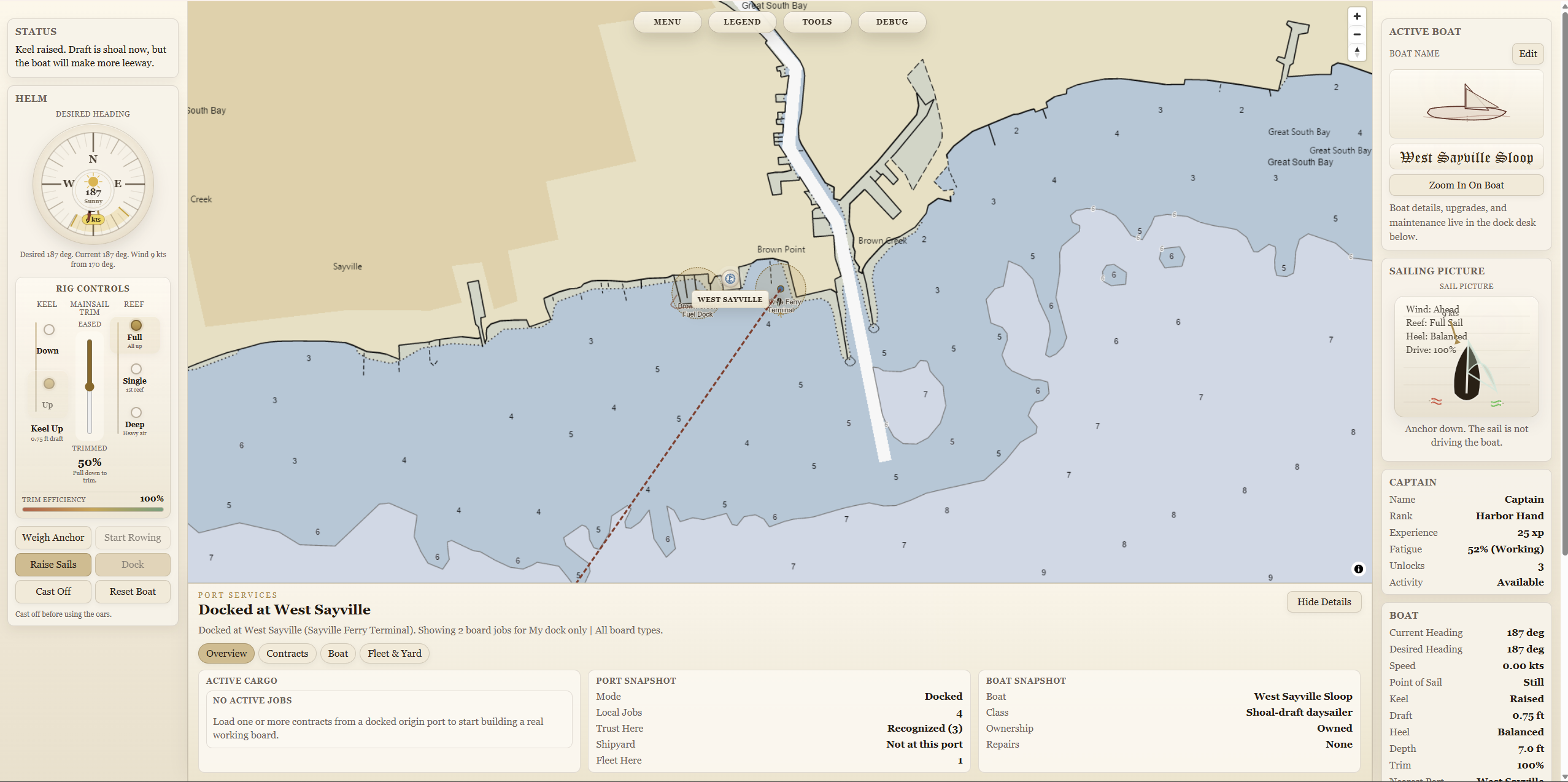
Portbound Seas already has the foundations of a persistent sailing game. The longer-term direction is to turn that foundation into a fuller working-bay sim where trade, tides, chart knowledge, crew, and boat choice all matter in everyday play.
Trade, cargo, and making a living under sail
One major direction is turning jobs and cargo into a more continuous economy. That means contract viability by boat and dock, persistent cargo and manifest handling, multi-stop runs, and a first real trading loop where goods can be bought in one place and sold in another. The point is to make sailing somewhere matter because the bay has an economy, not just a checklist of destinations.
Tides, currents, and chart knowledge
Another major pillar is making route planning depend on more than straight-line distance. Tide height should affect effective depth and approach feasibility. Current data should eventually matter for movement itself. Chart knowledge should also become part of progression: some detail is earned by exploration, while some can be unlocked by purchasable maps. The result should be a bay that becomes more legible as the player learns it.
A fuller Great South Bay
The world itself is meant to become denser and more believable, with more candidate stops, harbor traffic, shoreline interaction, anchorages, and tender access. The goal is not just a bigger map. The goal is a bay that feels lived in, with more reasons to stop, more local texture, and more working-waterfront decisions.
Life aboard and crew assistance
Portbound Seas is also moving toward a lighter life-aboard layer. That includes at-sea status reports, inspections, local observations, crew roles, skill-based assistance, rest, provisioning, safe anchorage, and slip logistics. The idea is not to bury the game in micromanagement. It is to make the captain and crew feel like part of the vessel, not detached menu stats.
Used boats, small craft, and the right hull for the job
Boat progression is also meant to widen. That includes a damaged used-boat market, more small craft under 19 feet, and a broader roster-and-stats pass so different hulls fit different work. In the long run, the interesting question should not be just “what is the best boat?” but “what is the right boat for this route, this harbor, this budget, and this weather?”
Why this future state matters
What ties all of this together is the core identity of the game: persistent sailing under real conditions. The future state is not about adding unrelated features. It is about deepening the same idea from multiple angles so contracts, charts, crew, hull choice, and local knowledge all feed into the same believable coastal sailing life.