Prototype proof of concept
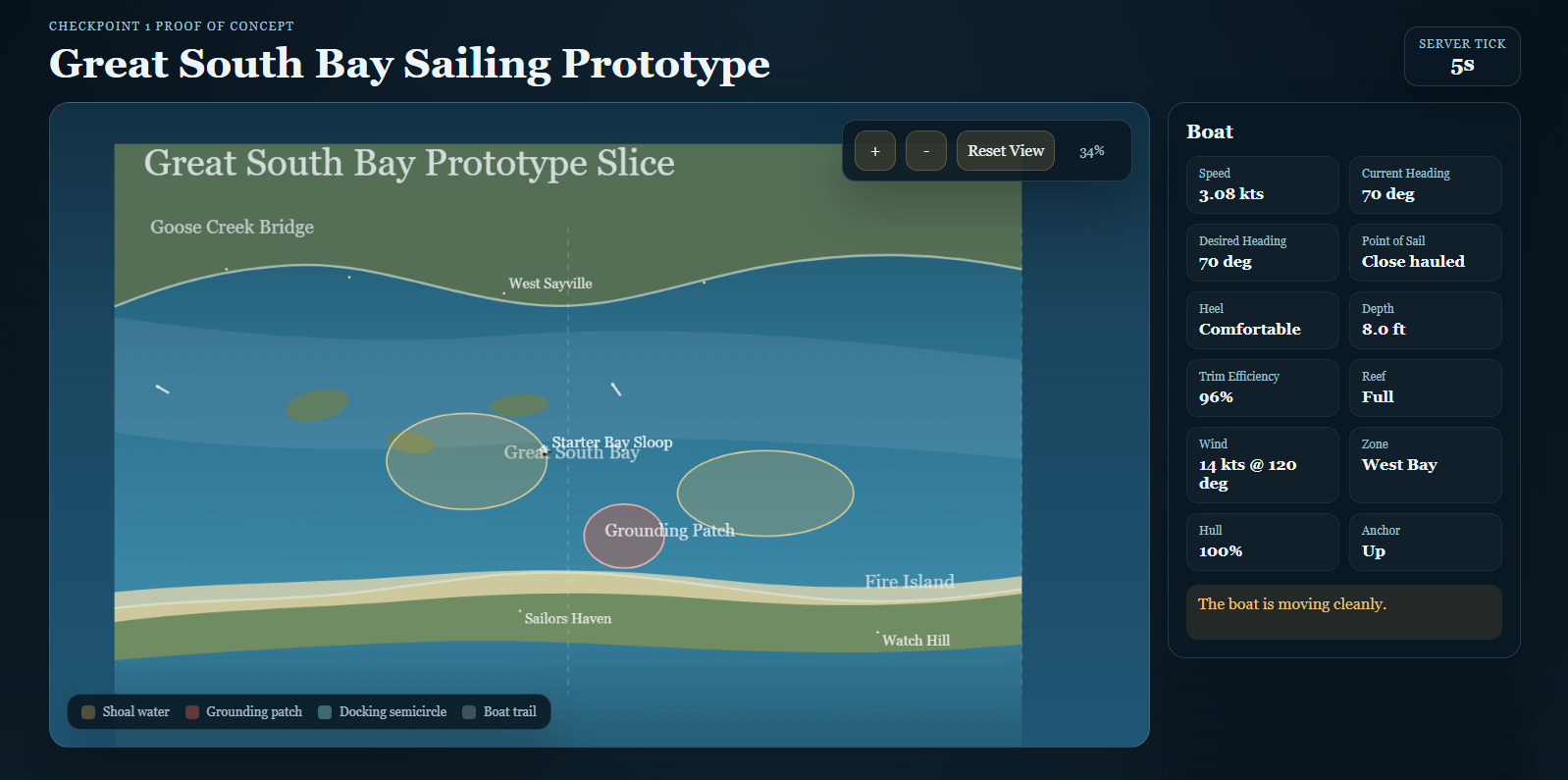
Before Portbound Seas became a NOAA chart-first Great South Bay prototype, it started as a focused proof of concept: a stylized bay slice, a moving sailboat, basic zones, and a compact boat-status panel.
What the prototype needed to prove
The first question was simple: could sailing around Great South Bay be readable and interesting enough to build on?
The proof of concept put several ideas on one screen: a simplified bay map, a starter boat, shallow water, docking areas, a grounding patch, a boat trail, and live boat state such as speed, heading, point of sail, heel, wind, trim efficiency, and anchor state.
Challenge: make sailing visible
Sailing is hard to communicate in a top-down game because the important information is often invisible. Wind direction, point of sail, heel, trim, and depth all affect the boat, but they need to be presented in a way the player can understand while still watching the map.
What changed after the first draft
The current build moved from the stylized prototype into a chart-first interface using Great South Bay map data. The systems became more detailed: helm controls, rig controls, dock panels, port services, contracts, active boat status, and sailing-picture feedback.
The proof of concept remains important because it established the direction: Portbound Seas is a sailing loop where the player reads conditions, adjusts the boat, and makes practical decisions around wind, depth, docks, and risk.